IOI
“Renewable energy” is a term that has been thrown around for a while now, but it is really a trend that is growing every day. People want to be more eco-friendly and sustainable, and companies have joined in. A decade after we first wrote this, solar is no longer a niche idea. It sits on rooftops, in power banks and even inside keyboards.
India shows how far things have moved. Under PM Surya Ghar: Muft Bijli Yojana, launched in 2024, residential rooftop solar had reached about 19,189 MW across more than 65 lakh households by October 2026, according to JMK Research. The scheme aims to reach one crore households, and the target date reported for that is March 2027. The central subsidy is ₹30,000 per kW for the first 2 kW and ₹18,000 for the third kW, capped at ₹78,000 for systems of 3 kW or more. Households apply through the national portal at pmsuryaghar.gov.in.
A rooftop system is a big decision, but you don’t need one to start using the sun. Many companies are marketing smaller solar devices to consumers, and it is important to understand what you’re getting before you spend money on them. We first published this list in November 2015. In this updated edition we checked every product again. Where the original model had been discontinued, we replaced it with a current one, from the same brand wherever possible.
A note on prices: the figures below are US list or sale prices shown on each brand’s website or on Amazon US in November 2026. Prices, stock and regional availability change often, so check the official page for your country before you buy.
1. YELOMIN Portable Solar Power Bank
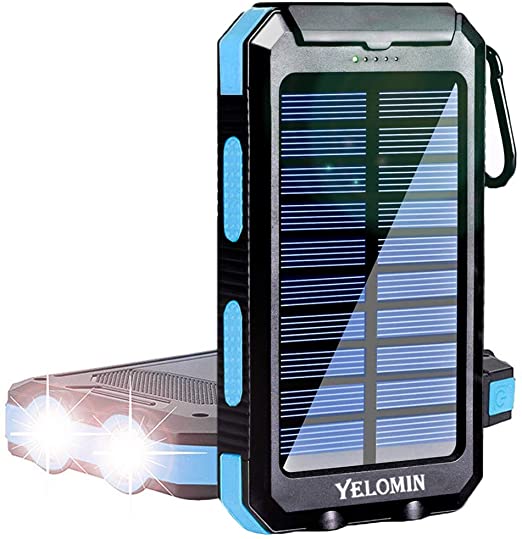
YELOMIN still makes the kind of solar power bank that opened our 2015 list, now with faster charging. Its current 20,000mAh models on Amazon US come with built-in charging cables, so you don’t need to carry a separate cord, and one version is listed with 22.5W fast charging and a dual flashlight. A 20,000mAh pack can top up most smartphones several times.
A small solar panel on the case tops up the battery when it sits in sunlight, and LED indicators show the charge level. Be realistic about that panel. The seller itself says a full solar charge can take several days, so it is best treated as emergency backup, with a wall charger doing most of the work. When we checked in November 2026, these models were listed at around $23 on Amazon US.
2. Soliom S600 Solar Outdoor Security Camera
Soliom’s S60 has been replaced by the S600. It is still a fully wireless camera that runs on a 7,500mAh battery and recharges from an attached solar panel, so there is no cable to run to the gate or garden. It records in 2K and can pan 320° and tilt 90° to cover a wide area, with 3x digital zoom.
Motion detection now combines a PIR sensor with human detection, which is meant to reduce false alerts from passing cars or swaying trees. A companion app sends you a notification and lets you watch live. Colour night vision reaches about 32 feet. Footage is saved to a microSD card of up to 128GB or to the cloud, with a 30-day cloud trial included, and the camera carries a two-year warranty. Soliom’s own store listed the S600 at $99.90 on sale (regular price $139.99) when we checked. A 4G version is offered for places without Wi-Fi.
3. LECLSTAR Solar Motion Sensor Outdoor Light
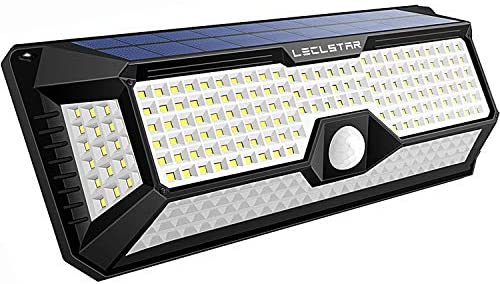
Whether or not you’re interested in a surveillance camera, the LECLSTAR Solar Motion Sensor Outdoor Light can still help protect your home. The light mounts with the supplied screws. There’s no need to worry about wires, since it recharges during the day.
The current version still uses 268 LEDs, but LECLSTAR now markets it at up to 4,000 lumens of 6500K daylight, up from the 1,800 lumens we listed in 2015, with light spread across four sides. An upgraded PIR sensor detects movement up to about 30 feet away across a 160° angle, and the light stays on for 30 seconds each time it is triggered. It is IP65 waterproof, has a 4,400mAh battery and offers three lighting modes, including a dim all-night setting. A two-pack was listed at $39.99 on Amazon US in November 2026.
4. ACOPOWER P1000 PLUS Portable Power Station
Adding a solar generator to the house can make a big difference. ACOPOWER no longer sells the 150Wh generator and 50W panel combo from our original list, and its range has grown in both directions.
At the larger end, the P1000 PLUS is a 1,024Wh power station with 1,800W of continuous output, enough to run many household appliances during a power cut, not just a fan or lamp. It uses a LiFePO4 battery rated for 4,000 cycles. It accepts up to 500W of solar input, and on AC it can charge from 0 to 80% in about 39 minutes. It can also act as a UPS, switching over in under 10 milliseconds, and can be controlled through an app. It weighs about 12kg and was listed at $438 on sale ($599 regular) on ACOPOWER’s website.
If you need something smaller, ACOPOWER’s 193Wh portable power station (HY-X230, $228) has a removable battery, USB-C PD 60W and USB-A quick-charge ports, and accepts solar input. It has DC and USB outputs only, so check that it suits your devices.
5. Logitech Signature Slim Solar+ K980 Keyboard
If your computer consumes a lot of energy, why use even more to power your accessories? Logitech has discontinued the K750 that we featured in 2015. Its successor, the Signature Slim Solar+ K980, launched in September 2025.
It uses Logi LightCharge to recharge from sunlight or indoor light. Once fully charged, Logitech says it can run for up to four months in total darkness, and the battery is designed to last up to 10 years. It has no charging port at all. It is a full-size keyboard with a number pad, works with Windows, macOS and other operating systems, and can switch between three devices. It sold for $99.99 in the US at launch, and it is listed on Logitech India’s website.
6. Goal Zero Crush Light Solar Lantern
Goal Zero has moved the Torch 250 flashlight from our original list into its archive, and it now shows as sold out. A good replacement from the same brand is the Crush Light, a collapsible solar lantern that folds down to just over half an inch thick.
It charges from its built-in solar panel in about 20 hours of sun, or in about 2.5 hours over USB-C. It gives 60 lumens on high, and its low setting can run for up to 35 hours. There is also a candle-flicker mode. At 91g and $29.95, it is easy to keep in a drawer for power cuts.
7. BioLite SolarHome 625 Solar Lighting Kit
Eton’s Rugged Rukus solar speaker has been discontinued. We have replaced it with a device that does more for a home: the BioLite SolarHome 625, a kit that turns sunlight into room lighting, phone charging and radio.
A 6W solar panel charges a control box with a 24.3Wh LiFePO4 battery in about six hours of strong, direct sun. The box powers three hanging lights of 130 lumens each, one of them with a motion sensor, and each light has its own switch and three brightness settings. The box also has two USB-A charging ports, an FM radio and an MP3 player that reads microSD cards. BioLite says the system is in daily use by millions of people across sub-Saharan Africa. It is listed at $299.95.
8. d.light S30 Solar Lantern
The Lattis Ellipse smart bike lock is no longer supported: its app was removed from Google Play in 2024. In its place we have chosen something many Indian homes use every day, the d.light S30 solar lantern.
d.light sells it in India through its local website. The integrated solar panel charges the lantern even on cloudy days, and a full charge gives up to 12 hours of light. d.light says it is four times brighter than a kerosene lamp. It has a carry handle and a flat base so it can stand on a table. d.light India also sells other solar lanterns and home-lighting kits. Check its website or local retailers for current prices.
9. Renogy 100W 12V Solar Panel Starter Kit
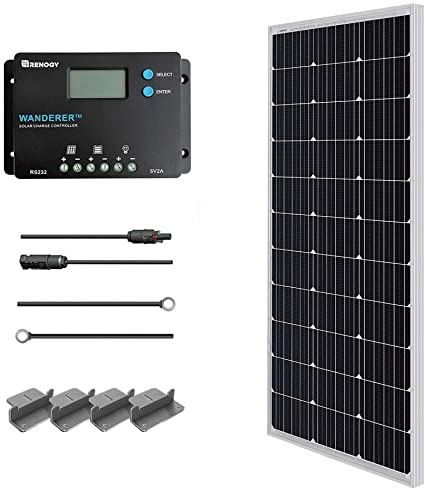
Renogy’s 100-watt starter kit is still one of the easiest ways to set up a small off-grid system. It is designed for people who are new to solar and want to power a shed, a boat, a camper van or a trailer.
The current kit pairs a 16BB N-type monocrystalline 100W panel with a Wanderer Li 30A PWM charge controller, along with a 20 ft solar adapter kit and an 8 ft tray cable to connect the controller to a battery. The controller supports up to 400W of panels on a 12V system, with a maximum PV input of 25V. The panel has a reinforced aluminium frame and 20 pre-drilled mounting holes, and weighs about 13 lb. You will need to add a deep-cycle battery to store power.
Renogy listed the kit at $159.99, although it showed as unavailable on renogy.com when we checked in November 2026. Handle the panel carefully during installation, because damage to the back surface can stop it delivering power.
10. HQST 100W 12V Monocrystalline Solar Panel
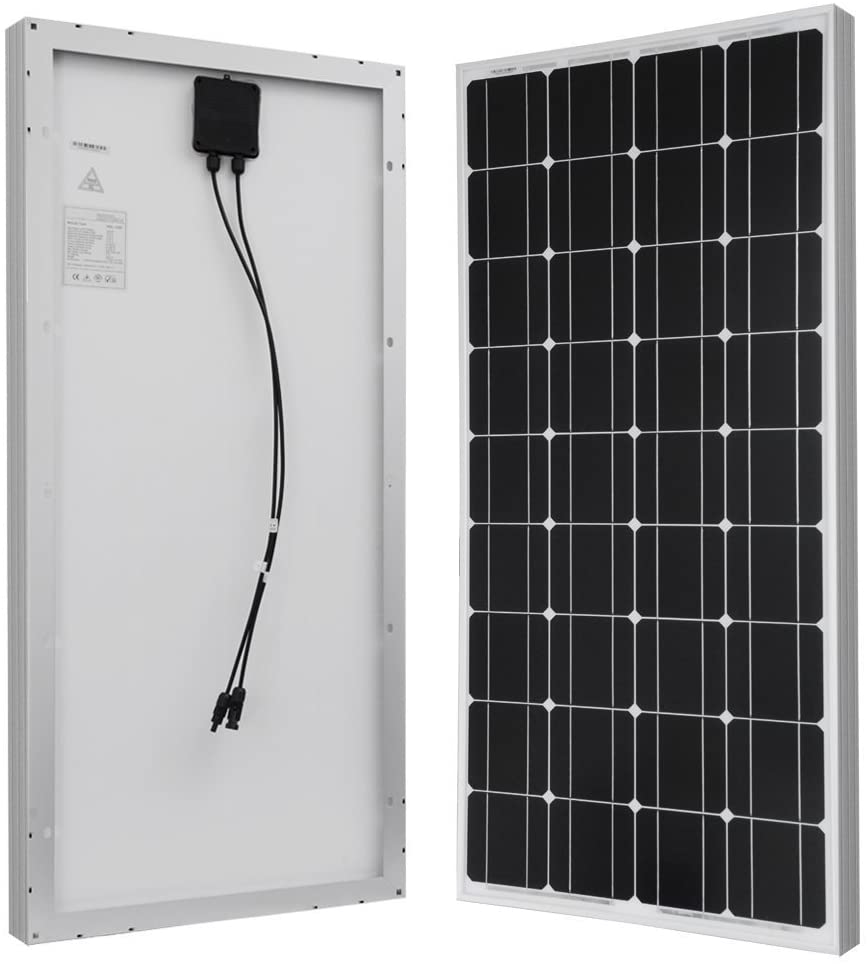
Our last pick is a monocrystalline solar panel from HQST, which still sells panels online. Its current 100W, 12V panel uses 9-busbar (9BB) cells, which are meant to improve efficiency and performance in low light.
Tempered glass and an anodised aluminium frame make the panel stiff and durable, and an IP65-rated junction box protects the wiring. Pre-drilled holes on the back make it easy to mount, and HQST says it can withstand high winds and snow loads. It weighs about 14.3 lb and was listed at $59.99 on HQST’s website, which makes it a low-cost way to expand a starter kit like the one above.
Choosing the right solar device
The right choice depends on what you want solar to do for you. For power cuts, a lantern such as the d.light S30 or Goal Zero Crush Light, or a solar power bank, covers the basics at a low price. Security cameras and motion lights can protect a home without any wiring. A power station such as the ACOPOWER P1000 PLUS, or a panel and controller kit, is a step towards running real appliances. For households in India that want to cut their electricity bills, rooftop solar under PM Surya Ghar is now the larger option. Whatever you choose, check warranties, service support in your city and the full price including shipping and import duties.
This article was first published in November 2015 and updated in November 2026 with current products, specifications and prices.