IOI
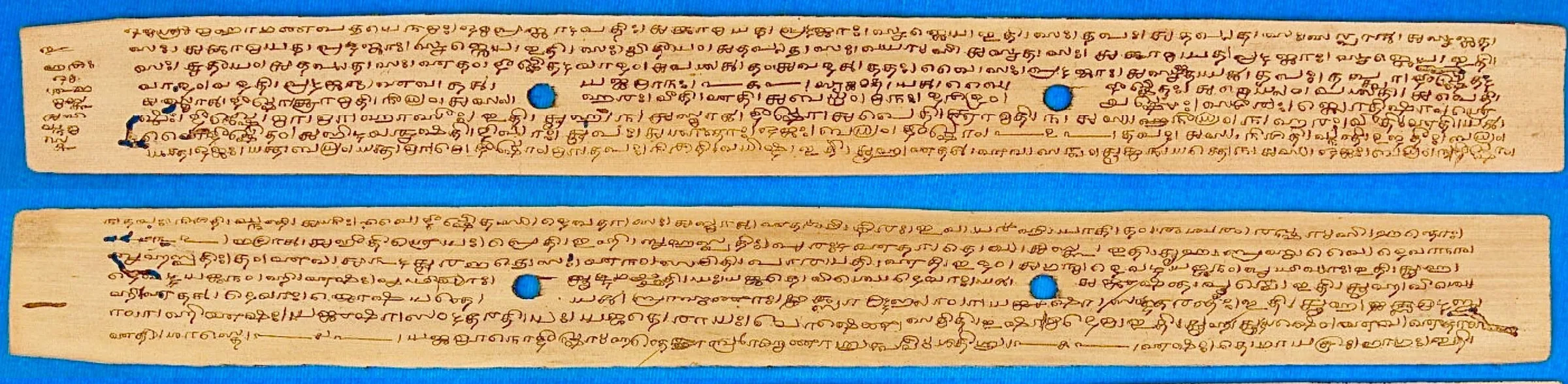
India holds one of the largest manuscript collections on Earth, much of it written on palm leaf, birch bark and handmade paper, and much of it unread for generations. Now the government wants artificial intelligence to do something no scholar could do alone: read more than one crore (10 million) of these manuscripts, make them searchable, and let anyone ask them questions.
According to The New Indian Express, the Ministry of Culture is set to deploy AI and machine learning under its flagship Gyan Bharatam initiative to decipher, digitise and preserve the collection. The plan includes a National Digital Repository where users can search by text or voice, and a “Talk-to-Manuscript” feature for asking questions about a single text or a whole field of knowledge.
What the ministry is building
The technical core is optical character recognition (OCR, software that turns a printed page into editable text) and handwritten text recognition (HTR, the same for handwriting). The goal is to turn manuscript images into searchable text while keeping their original structure, including headings, marginal notes and illustrations.
Officials told the paper the AI will also help transcribe and translate texts, identify authors, trace where a manuscript came from, reconstruct faded passages and find links between manuscripts held by different institutions and private collectors. The ministry is in the process of engaging an expert technology firm to build the platform.
One rule stands out. Every AI-generated answer will have to be supported by validated manuscript records, with page-level citations and quotations from the original source. In a world where chatbots confidently invent facts, that is the right design choice for a national archive.
The numbers behind the mission
- Funding: The Standing Finance Committee has sanctioned Rs 491.66 crore for Gyan Bharatam for 2025 to 2031. The mission was announced in the 2025 Union Budget.
- Scale: More than 1.25 crore manuscripts have been reported on the Gyan Bharatam portal, and 11.53 lakh have been published so far, per the ministry figures reported by The New Indian Express.
- People: The ministry plans new conservation labs for palm-leaf, birch-bark and paper manuscripts, and a network of trained volunteers called Pandulipi Mitras (manuscript friends) across about 100 districts.
- Provenance: The Ministry of Culture’s mission page also lists blockchain for tracking the provenance of digitised manuscripts, and APIs to connect with national and international archives.
India’s own AI is doing the reading
The most interesting part is who is building the early tools. BharatGen, the government-backed AI initiative based at IIT Bombay, is running an active pilot with the ministry. In a detailed note on the project, it describes two tools.
Pāṇḍulipi Saṃśodhaka (“manuscript corrector”) reads Sanskrit manuscripts with OCR. It draws boxes around each line and character so a reader can see exactly which part of the image produced which part of the text, shows a confidence score so uncertain readings stand out, and uses a vision language model to help with corrections. BharatGen says it has been trained and tested on more than a thousand manuscripts.
Jñāna Saṃvāda (“a dialogue with knowledge”) is conversational AI over manuscripts. A learner can type or speak a question and get an answer drawn from curated manuscript extracts, using retrieval-augmented generation (RAG, where the AI first finds the relevant passages and then answers only from them) along with speech-to-text and text-to-speech.
“The aim is not to remove the scholar. It is to change the scholar’s work from typing out a page to checking and correcting a draft.”
BharatGen, on the Gyan Bharatam pilot
Writing in Business Standard, economic analyst Pranjal Sharma notes that the pilot focuses on Sanskrit texts in mathematics, astronomy and medicine, and that researchers at the IITs and IISc have already applied language AI to works such as Aryabhata’s Aryabhatiya and Bhaskaracharya’s Lilavati.
A global effort, too
Many Indian manuscripts sit in libraries abroad. On 26 October, the Ministry of Culture signed an agreement with the Bibliothèque nationale de France, France’s national library, with the participation of the Gyan Bharatam Mission, to cooperate on preserving and digitising Indic manuscripts.
The work on the ground is moving as well. Visva-Bharati says digitisation of rare manuscripts at its Lipika Manuscriptorium began on 31 October, led by an expert team from the Asiatic Society under the mission.
Why this matters
For most of history, reading an old manuscript meant finding it, getting permission to handle it, and knowing the script. Each of those was a barrier. AI will not remove the need for experts, but it can make the first draft cheap and the search instant. A student in Patna or a researcher in Pune could, in principle, ask what a 15th-century text says about eclipses and get an answer with the page it came from.
There are real challenges. Faded ink, damaged leaves, dozens of scripts and the habits of individual scribes make this some of the hardest material for any OCR system. Many manuscripts are still held by families and temples, so trust and clear terms will matter as much as technology. And the gap between manuscripts reported and manuscripts published shows how much work is left.
Still, the direction is right. India is using its own AI, built by its own institutions, to unlock its own knowledge, and insisting that every answer comes with a citation. That is a model other countries with deep archives will be watching.
Sources: The New Indian Express (7 Nov 2026), BharatGen, Business Standard (8 Nov 2026), Ministry of Culture. Featured image: palm-leaf manuscript by Savithri / Wikimedia Commons, CC BY-SA 4.0 (cropped). In-body image: Ms Sarah Welch / Wikimedia Commons, CC BY-SA 4.0 (cropped).