IOI
We first published this explainer in May 2021. Five years on, the basic difference between the two is the same, but almost everything around it has changed: SpaceX is now a listed company, NASA has sent astronauts around the Moon again, and the two are more tightly linked than ever. We have refreshed this story with the latest facts and figures as of November 2026.
SpaceX and NASA: their goals and vision
SpaceX is a private aerospace manufacturer and space transport company. It was founded by Elon Musk in 2002. NASA is the American space agency, and it was founded in 1958. The space industry is as wide open to explore as it was decades ago, and SpaceX, the much younger organisation, has progressed a great deal in a short time. It is developing new ways to send people and cargo into space.
So what is the difference between a company like SpaceX and an agency like NASA? The simplest answer is still the one we gave in 2021: SpaceX is a company and NASA is a government agency. NASA’s goal is to do research, explore and develop new technology on behalf of the public. SpaceX’s goal is to build the technology to carry people and payloads to the Moon, Mars and beyond, and to run that as a business.
In 2021 we wrote that SpaceX was competing with NASA. Today it is more accurate to say that the two depend on each other. NASA is one of SpaceX’s most important customers, and SpaceX rockets and capsules now carry many of NASA’s astronauts and missions. Here is how the relationship looks in 2026.
A public agency and, now, a public company
For most of its life, SpaceX was privately held. That changed this year. SpaceX listed on Nasdaq under the ticker SPCX on 12 June 2026. The shares were priced at US$135, and the offering raised a record US$75 billion, valuing the company at about US$1.77 trillion, Reuters reported. After underwriters bought additional shares, total gross proceeds reached about US$85.7 billion. According to Reuters, Musk kept about 82% control of the company after the listing.
SpaceX is also a much broader business than the rocket maker we described in 2021. Before its listing, it acquired Musk’s AI company xAI and the social platform X. In the three months to 30 September 2026, Starlink brought in US$5.2 billion in revenue, and SpaceX’s AI computing business brought in US$7.5 billion, according to the BBC. Over the first nine months of the year, revenue rose to US$27 billion from US$13.7 billion. The company reported a US$1.1 billion loss over that period, despite a US$4.4 billion profit in the most recent quarter. Musk has also said Tesla and SpaceX have set up special committees to study a possible merger, although no terms have been agreed.
NASA, by contrast, is funded by American taxpayers through Congress. For fiscal year 2026, NASA received about US$24.44 billion, broadly in line with the previous year and well above the much smaller amount the White House had requested, according to an analysis of the enacted budget. For fiscal year 2027, the administration has proposed cutting NASA’s budget by about 23% to US$18.8 billion, SAN reported. Congress will decide the final number.
Reusable rockets: the change that set SpaceX apart
SpaceX became famous for launching rockets and satellites and for bringing part of its rocket back to Earth. When Musk founded SpaceX, he wanted rockets to be reusable, so that the same hardware could fly again and again. On 21 December 2015, a Falcon 9 first stage landed upright at Cape Canaveral after launching 11 ORBCOMM satellites. It was the first time an orbital-class booster had been recovered this way.
NASA has reused rocket hardware too. During the Space Shuttle era, the shuttle’s solid rocket boosters parachuted into the Atlantic, where NASA recovery ships retrieved them to be refurbished and flown again. That programme ended with the shuttle in 2011. SpaceX’s approach, landing the booster itself under its own power, has since become routine.

The numbers in 2026 show how far that has gone. A classified US Space Force mission on 6 November was the 119th Falcon 9 launch of the year, Space.com reported, and more than 70% of this year’s Falcon 9 missions have carried Starlink satellites. The booster on that flight was making its eighth flight. As of 9 November, every Falcon 9 and Falcon Heavy booster landing attempt in 2026 had succeeded, according to the tracker The Space Road.
SpaceX’s next goal is a rocket that is fully reusable, both stages. Its giant Starship reached orbit for the first time on Flight 14 on 28 September 2026 and deployed 26 Starlink V3 satellites. Flight 15, targeted for as early as 13 November (pending regulatory approval), is planned to be the first attempt to catch both the Super Heavy booster and the Starship upper stage with the launch tower at Starbase, Texas. “If successful, this will mark the first full recovery of an orbital launch system,” SpaceX says.
NASA in 2026: back around the Moon
In 2021 we wrote that NASA had become more of a traditional government organisation. This year it delivered its biggest human spaceflight milestone in decades. Artemis II launched on NASA’s SLS rocket on 1 April 2026 and splashed down off San Diego on 10 April. Its crew, NASA astronauts Reid Wiseman, Victor Glover and Christina Koch and Canadian astronaut Jeremy Hansen, became the first people to travel to the Moon’s vicinity in more than half a century. At their farthest, they were 252,756 miles (about 406,770 km) from Earth, farther than any humans before them, according to NASA.
NASA is also changing how it works. Jared Isaacman, a tech entrepreneur who has flown to orbit twice on SpaceX missions, was confirmed as NASA Administrator in December 2025. NASA lost nearly 4,000 civil servants in 2025 through deferred resignation programmes. Isaacman now plans to convert about 7,500 contractor positions into civil service jobs to rebuild in-house expertise, Ars Technica reported. In a May message to staff, he wrote that early pilots had already found more than US$100 million in annual savings.
NASA’s science missions continue too, often on commercial rockets. Its Nancy Grace Roman Space Telescope, built to study dark energy and dark matter, launched on 30 August 2026 aboard a SpaceX Falcon Heavy from Kennedy Space Center.
Partners more than rivals
The clearest sign of how intertwined the two have become is who carries NASA’s astronauts. Since 2020, crews have flown to the International Space Station on SpaceX’s Dragon under NASA’s Commercial Crew Program. On 1 October 2026, Falcon 9 launched Crew-13, Dragon’s 13th operational crew rotation mission for NASA, with Jessica Watkins, Luke Delaney, Joshua Kutryk and Sergey Teteryatnikov on board.
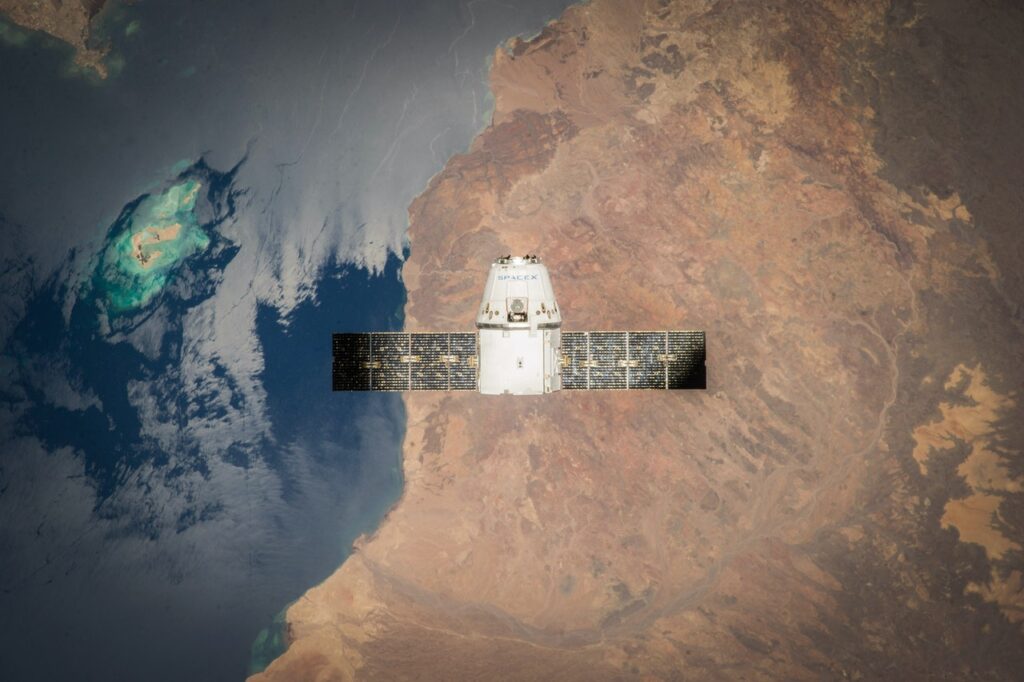
The Moon is the next shared project. In April 2021, NASA selected SpaceX’s Starship as the first crewed lander for its Artemis programme, and Blue Origin was later chosen to build a second lander. NASA has since reshaped the plan. Artemis III, launching in 2027, will now stay in Earth orbit for about 14 days. Its four astronauts will dock their Orion spacecraft with a test version of Blue Origin’s Blue Moon lander and then with a Starship test vehicle. A crewed Moon landing is targeted for Artemis IV in 2028, and NASA says neither lander provider is currently assigned to a specific landing mission. It will decide based on which lander is ready.
The two organisations still build and buy rockets in different ways. NASA owns its SLS rocket and Orion capsule, and its Office of Inspector General has projected that the SLS/Orion system and its ground infrastructure will cost at least US$4.2 billion per launch for the first four Artemis missions. SpaceX designs and owns its vehicles and sells launches and services to NASA and other customers. Supporters of each approach make their case: NASA’s model keeps critical capability in public hands, while commercial contracts can spread costs across many customers.
Mars is still the dream, but the Moon comes first
Musk has said for more than two decades that he founded SpaceX to help make humanity a multi-planetary species, with Mars as the destination. In 2021 we wrote that his future plans were yet to be seen. In February 2026, he changed the order. “SpaceX has already shifted focus to building a self-growing city on the moon, as we can potentially achieve that in less than 10 years, whereas Mars would take 20+ years,” he wrote on X, as reported by Space.com. He explained that Mars launch windows open only every 26 months, while the Moon can be reached every 10 days. He has said Mars work will start in five or six years, in parallel with the Moon.
NASA also lists Mars as its long-term goal. It says Artemis will help it establish an enduring presence on the Moon and build the foundation for the first crewed mission to Mars.
Why it matters for India
The NASA and SpaceX story now runs through India too. In June 2025, ISRO astronaut Group Captain Shubhanshu Shukla flew to the International Space Station as pilot of Axiom Mission 4. He launched on a Falcon 9 and Dragon and spent 18 days on the station, the outcome of a NASA-ISRO collaboration, ISRO said. The Dragon capsule that carried him later flew NASA’s Crew-13 mission. In July 2025, ISRO’s GSLV-F16 launched NISAR, a joint NASA-ISRO Earth-observation radar satellite.
SpaceX’s Starlink, meanwhile, is still waiting to start commercial service in India. In October 2026, India’s Ministry of Communications said Starlink, Eutelsat OneWeb and Jio Satellite Communications were at broadly the same stage, all awaiting security clearances and spectrum allocation, the BBC reported.
SpaceX vs NASA at a glance (November 2026)
| SpaceX | NASA | |
|---|---|---|
| What it is | Company, listed on Nasdaq (SPCX) since June 2026 | US government space agency |
| Founded | 2002, by Elon Musk | 1958 |
| Led by | Elon Musk, founder and CEO | Administrator Jared Isaacman (since December 2025) |
| Money | Revenue of US$27 billion in the first nine months of 2026, from launches, Starlink, AI computing and more | About US$24.44 billion budget for FY2026, set by Congress |
| Main rockets and spacecraft | Falcon 9, Falcon Heavy, Dragon, Starship | SLS rocket and Orion spacecraft; also buys launches from companies including SpaceX |
| 2026 highlights | Starship reaches orbit (Flight 14); 119 Falcon 9 launches by 6 November | Artemis II crew flies around the Moon; Roman Space Telescope launches |
| Next big goal | Fully reusable Starship; a city on the Moon, then Mars | Artemis III in Earth orbit (2027); crewed Moon landing (2028) |
Conclusion
SpaceX, formally Space Exploration Technologies Corp., is an American aerospace manufacturer and space transport company, now headquartered at Starbase, Texas. It was founded in 2002 by Elon Musk with the goal of reducing space transportation costs and, eventually, enabling the settlement of other worlds. In just over two decades, it has become one of the most important companies in the space industry, and since June 2026 one of the most valuable listed companies in the world.
NASA, at 68, remains the agency that sets America’s goals in space and pays for much of the science and exploration that companies like SpaceX help deliver. The difference between them is still that one is a company and one is a public agency. What has changed since 2021 is how much each now relies on the other.