IOI
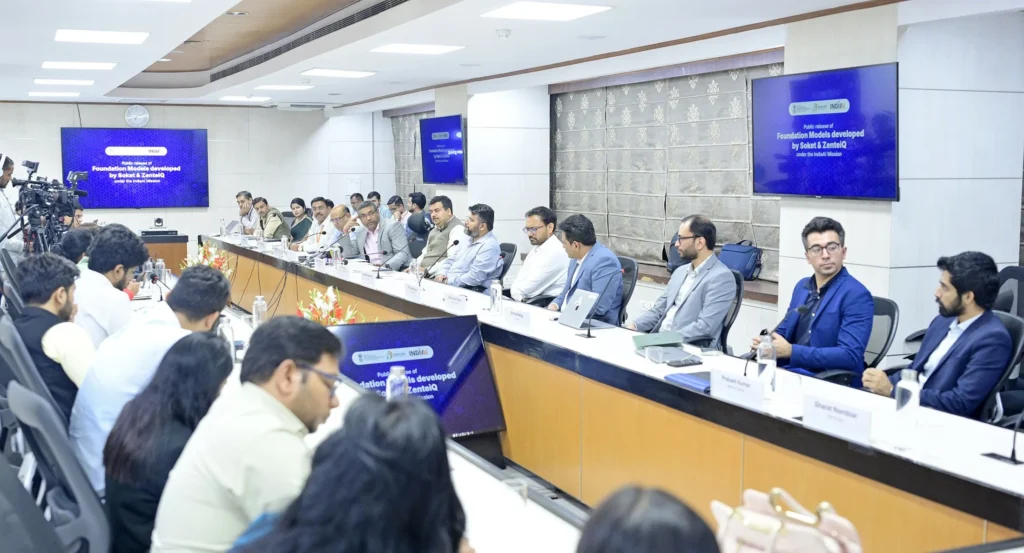
On the evening of 3 November, in a conference room in New Delhi, the IndiaAI Mission released three artificial intelligence models built by Indian startups. One is a 26.3-billion-parameter system meant to reason through maths and code in every scheduled Indian language. The other two are small enough, their makers say, to run on a phone with no internet connection at all. Together, they are the newest indigenous AI models India has produced under the mission.
According to the Press Information Bureau, the models are EKA-1, developed by Soket Labs Technology and Research, and Dhīr 2B and Dhīr 5B, developed by ZenteiQ AiTech Innovations. They were unveiled in the presence of S. Krishnan, Secretary of the Ministry of Electronics and Information Technology (MeitY), along with IndiaAI officials and both companies’ leadership teams.
EKA-1: a large model for maths, code and reasoning
PIB describes EKA-1 as an open, sparse hybrid language model with 26.3 billion parameters (the adjustable values a model learns during training), trained on roughly 7.5 trillion tokens (the small chunks of text a model reads). It covers all 22 languages in the Eighth Schedule of the Constitution plus English, and is designed for maths, code, reasoning and agentic use, meaning tasks where the AI plans and carries out several steps on its own.
“Sparse” means that only part of the network is switched on for each word it processes. In its own launch post, Soket put numbers on that design: 52 layers and 128 experts, the specialised sub-networks a router chooses between. The company also says the model handles more than 100 languages, a wider count than the 22-plus-English figure in the government release. Mint’s report describes that larger set as Indian and international languages along with programming languages. Mint, carrying an ANI report, says EKA-1 can execute code and run on-premises, in a private cloud or in air-gapped environments.
Soket’s chief executive, Abhishek Upperwal, framed the model around specific industries. “With the support of the IndiaAI Mission, we have developed an advanced AI model specifically tailored to India’s unique banking, financial services and cybersecurity landscape,” he said at the release. On access, Soket’s website currently offers EKA-1 through an early-access waitlist rather than a public download. At the time of writing, no EKA-1 weights appeared on the company’s Hugging Face page.
Dhīr: small models that stay on the device
ZenteiQ took the opposite approach. Its two Dhīr models are open source and are intended as secure, on-premises assistants in English and 10 Indian languages. PIB lists their uses as offline document work, knowledge retrieval and citizen or enterprise services in defence, government, industry and education, especially where connectivity is poor or the data is sensitive.
The company’s model page gives the details. Dhīr 2B is a dense model with 2.03 billion parameters. Dhīr 5B is a mixture-of-experts model with 5.09 billion parameters in total, of which 1.79 billion are active for each token, because every token is routed to 2 of its 12 experts. Both read more than six trillion tokens during pretraining, both handle up to 16,384 tokens of context, and both cover Hindi, Bengali, Tamil, Telugu, Marathi, Gujarati, Kannada, Malayalam, Punjabi and Odia alongside English. Compressed to 4-bit, the smaller model is a 1.21 GB file.
ZenteiQ chief executive Prof. Sashikumaar Ganesan told Hindustan Times that with a cloud chatbot, the answer is produced on a remote server, whereas in an air-gapped setup it is produced locally. “No data will go outside,” he said, adding that the models can run on a phone with at least 6 GB of memory. ZenteiQ is releasing the weights under the Apache 2.0 licence through AIKosh, the IndiaAI datasets and models platform, Mint reports.
The company is also open about limits. Its page says recalling facts without a supporting source is the models’ weakest area, recommends retrieval and human review for law, finance, medicine and similar fields, and notes that neither model has a reasoning mode. In ZenteiQ’s own testing against 24 open models of 1 to 7 billion parameters, Dhīr 5B averaged 64.6 per cent and Dhīr 2B 61.4 per cent across 41 benchmarks. These scores are self-reported, and the company has published its evaluation tools so others can check them.
Chips, and the choices behind them
According to PIB, both teams were selected under the IndiaAI Innovation Centre (Foundation Models) pillar and given subsidised access to national AI compute plus support for related research costs. By a Lok Sabha reply in April 2026, the mission had empanelled more than 38,000 GPUs through 14 providers at an average of about Rs 65 per GPU-hour, with 20,000 more being added.
ZenteiQ went a different way. Its technical blog says every training stage ran on Google Cloud TPU v6e chips in Mumbai. Ganesan told Hindustan Times this was because GPUs were scarce, and that waiting for them would have cost another three to four months. He added that TPUs are not inferior to GPUs. At the launch, Secretary Krishnan pointed to a different advantage of the new models.
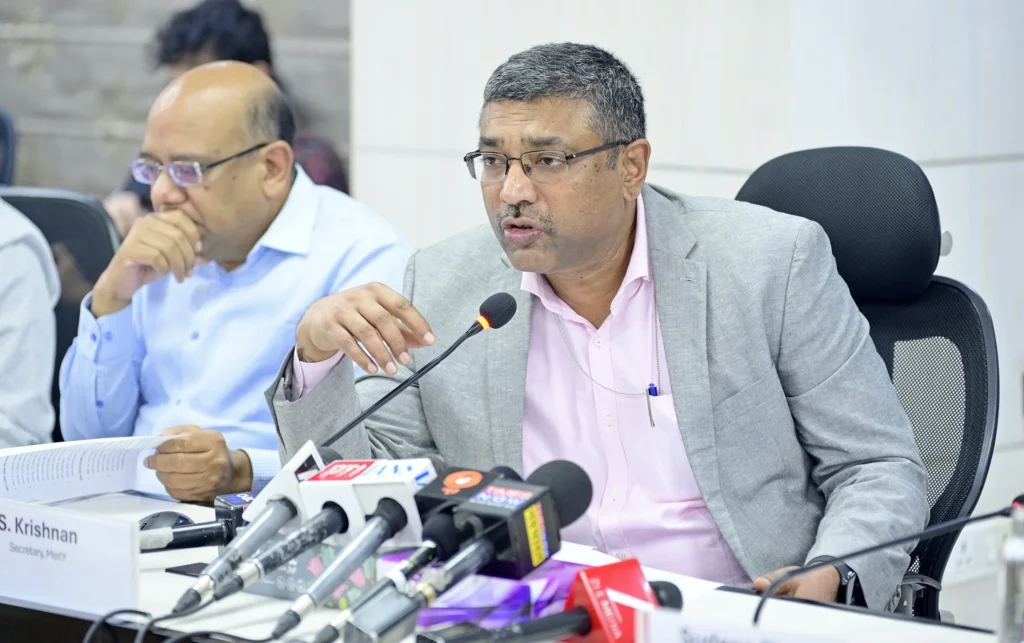
“These models can be deployed on air-gapped environments, which means enterprise-based artificial intelligence, which thus far hasn’t really taken off, would be possible to do a lot more of that in the country using models like this.”
S. Krishnan, Secretary, MeitY, as reported by ANI
Where they fit
The two releases join a growing shelf. In a Lok Sabha answer on 29 July 2026, the government said 506 applications had produced 20 supported model proposals, 12 large multimodal models and 8 small language models. It also listed models already released: Sarvam AI’s 30-billion and 105-billion-parameter models, BharatGen’s Param2-17B, Gnani.AI’s speech-to-speech model and Avataar AI’s video model. (BharatGen’s work on reading ancient manuscripts is covered in our earlier story on Gyan Bharatam.)
Bigger models are still to come. The government’s list of selected proposals describes Soket’s goal as a 120-billion-parameter open-source model, and Soket’s website says a model of more than 120 billion parameters is in training. ZenteiQ says a Dhīr 9B is in development. The government says models from the mission are meant to be shared through AIKosh with researchers, students and startups.
Several questions remain open: whether independent tests will match the self-reported scores, when EKA-1’s weights will be released to the public, and how widely banks, ministries and factories will use AI that runs inside their own walls. For now, the release shows two quite different ideas of what Indian AI can look like. One is a large reasoning model aimed at specialist industries. The other is a small model that keeps working when the network drops.
Sources: Press Information Bureau (3 Nov 2026), Hindustan Times (4 Nov 2026), Mint / ANI (3 Nov 2026), The Hindu BusinessLine (4 Nov 2026), ZenteiQ, Soket AI, Lok Sabha replies of 1 Apr 2026 and 29 Jul 2026. Photos: PIB.