IOI
IOI
In a defining chapter of India’s space odyssey, Prime Minister Narendra Modi extended heartfelt congratulations to the team at Skyroot Aerospace following the spectacular success of Vikram-1, India’s first privately developed orbital launch vehicle. The launch on July 18, 2026, from the Satish Dhawan Space Centre in Sriharikota, has propelled the nation into an elite league of countries with private orbital capabilities, joining the United States and China.
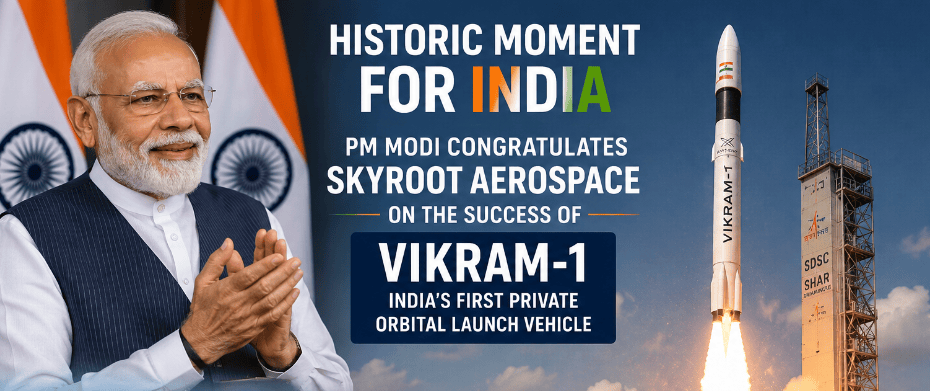
The image above captures PM Modi’s official message on X, where he praised the achievement as a “defining moment in India’s space journey.” Flanked by the national tricolor and the Ashoka Chakra flag in his office, the Prime Minister highlighted how private sector participation is accelerating innovation and inspiring the youth to dream fearlessly.
The Dawn of a New Era in Indian Space Tech
Skyroot Aerospace, founded in 2018 by former ISRO scientists Pawan Kumar Chandana and Naga Bharath Daka, has rewritten the rules of space access. Their rocket, named after Vikram Sarabhai, the father of the Indian space program, completed “Mission Aagaman” successfully on its maiden attempt. The three-stage solid and one-stage liquid propulsion system injected customer payloads into a ~450 km low Earth orbit approximately 15 minutes after liftoff.
This feat is remarkable not just for its technical precision but for the speed at which a young startup accomplished it. With an average team age of around 28, Skyroot demonstrates the immense potential of India’s talent pool when empowered by entrepreneurship and supportive infrastructure from ISRO. Early backing from investors like Myntra founder Mukesh Bansal helped fuel this journey.
Unlike traditional government-led missions, private players like Skyroot bring agility, cost-efficiency, and rapid iteration, qualities essential for competing in the booming global commercial space market, valued at hundreds of billions of dollars.

Significance for Innovation and Self-Reliance
PM Modi’s personal phone call to the Skyroot team underscores the government’s commitment to fostering private innovation under the Atmanirbhar Bharat initiative. In his message, he noted: “The growing participation of our private sector is opening new frontiers and accelerating innovation.” This success validates policies that encourage startups in critical sectors like aerospace, defense, and deep tech.
For India’s innovation ecosystem, Vikram-1’s triumph has far-reaching implications:
- Economic Growth: Affordable, on-demand launches will lower barriers for satellite deployment, Earth observation, communication, and scientific experiments.
- Global Positioning: India now stands as a credible player in the international space launch services market, potentially attracting foreign payloads and collaborations.
- Inspiration for Youth: As Modi emphasized, such achievements motivate countless young Indians to pursue STEM careers and entrepreneurship, building a robust pipeline of innovators.
- Ecosystem Ripple Effects: Companies like Agnikul Cosmos and satellite firms such as Pixxel are likely to benefit from this momentum, creating a vibrant private space cluster.
This milestone arrives at a time when space technology is democratizing access to data, connectivity, and exploration. From climate monitoring to disaster management, reliable private launch capabilities strengthen national resilience and open commercial avenues.
Challenges and the Road Ahead
While the launch is a resounding success, challenges remain. Sustainable propulsion, reusability, regulatory frameworks, and scaling operations will be key focus areas. Skyroot has already signaled ambitions for more frequent launches and advanced vehicles, aligning with India’s goal of becoming a global space leader.
The integration of public institutions like ISRO with private ingenuity creates a powerful model. It proves that innovation thrives when bureaucracy gives way to collaboration and risk-taking.
Fueling Dreams, Reaching for the Stars
Skyroot Aerospace’s Vikram-1 launch is more than a rocket test, it symbolizes India’s rising confidence in its private sector to tackle complex, frontier technologies. As PM Modi aptly put it, this will encourage future generations to innovate without limits.
For India’s innovation enthusiasts, this is a call to action. Whether in aerospace, AI, renewable energy, or biotech, the spirit of Vikram-1 reminds us that bold visions, executed with precision, can transform aspirations into orbital realities.
As we celebrate this historic achievement, let it ignite fresh conversations on nurturing deep-tech startups and building an innovation-driven economy. The stars are no longer the limit, they are the destination.