IOI
When Brazil’s Superior Electoral Court finished counting 100% of the ballots on Sunday night, 25 October 2026, 80-year-old President Luiz Inácio Lula da Silva had pulled off one of the most closely watched political comebacks in modern Latin American history. Trailing after the first round, the veteran leader won the presidential runoff with 51.8% of the vote—a margin of nearly 4.4 million ballots over Senator Flávio Bolsonaro, who finished at 48.2%—securing an unprecedented fourth term at the helm of South America’s largest economy.
Within hours of the result on Monday, 26 October, Prime Minister Narendra Modi took to Instagram and X—posting in both English and Portuguese—to congratulate his “dear friend, President Lula,” and to signal that New Delhi and Brasília intend to keep their foot on the accelerator of a rapidly expanding bilateral relationship.
Heartiest congratulations to my dear friend, President Lula, on his remarkable re-election victory.
— Narendra Modi (@narendramodi) October 26, 2026
I look forward to working closely with him to further deepen and expand the multifaceted India-Brazil Strategic Partnership.
Together, we will continue to strengthen our cooperation across diverse sectors, advance the shared priorities of the Global South and work towards a more inclusive, equitable and sustainable world.
@LulaOficial
Replying directly to Prime Minister Modi’s Portuguese message on X, President Lula pointed to the momentum built during his State Visit to New Delhi earlier this year and praised India’s stewardship of the 2026 BRICS Presidency: “Thank you very much for your words, my friend Prime Minister Narendra Modi. I fondly remember the visit I made to India in February of this year, when we took new steps to strengthen our Strategic Partnership, especially in the areas of trade, health, and technology. I congratulate India on leading the BRICS presidency in 2026, continuing the work carried out by Brazil last year.”
@narendramodi Muito obrigado pelas palavras, meu amigo primeiro-ministro Narendra Modi, @narendramodi.
— Lula (@LulaOficial) October 26, 2026
Guardo com alegria a visita que fiz à Índia em fevereiro deste ano, quando demos novos passos para fortalecer nossa Parceria Estratégica, especialmente nas áreas de comércio, saúde e tecnologia.
Parabenizo a Índia pela condução da presidência do BRICS em 2026, dando continuidade ao trabalho realizado pelo Brasil no ano passado.
Seguiremos juntos, no BRICS e no G20, defendendo o multilateralismo, ampliando a voz do Sul Global e construindo uma ordem internacional mais justa, inclusiva e pacífica.
Seven decades of diplomacy and two back-to-back State Visits
Although separated by more than 14,000 kilometres, India and Brazil established formal diplomatic relations in 1948, when independent India opened its first South American mission in Rio de Janeiro before shifting to the newly built capital of Brasília in 1971. It was during Lula’s first presidential term in 2006 that the two countries formally elevated their ties to a Strategic Partnership—two years after Lula served as Chief Guest at India’s 55th Republic Day parade in 2004.
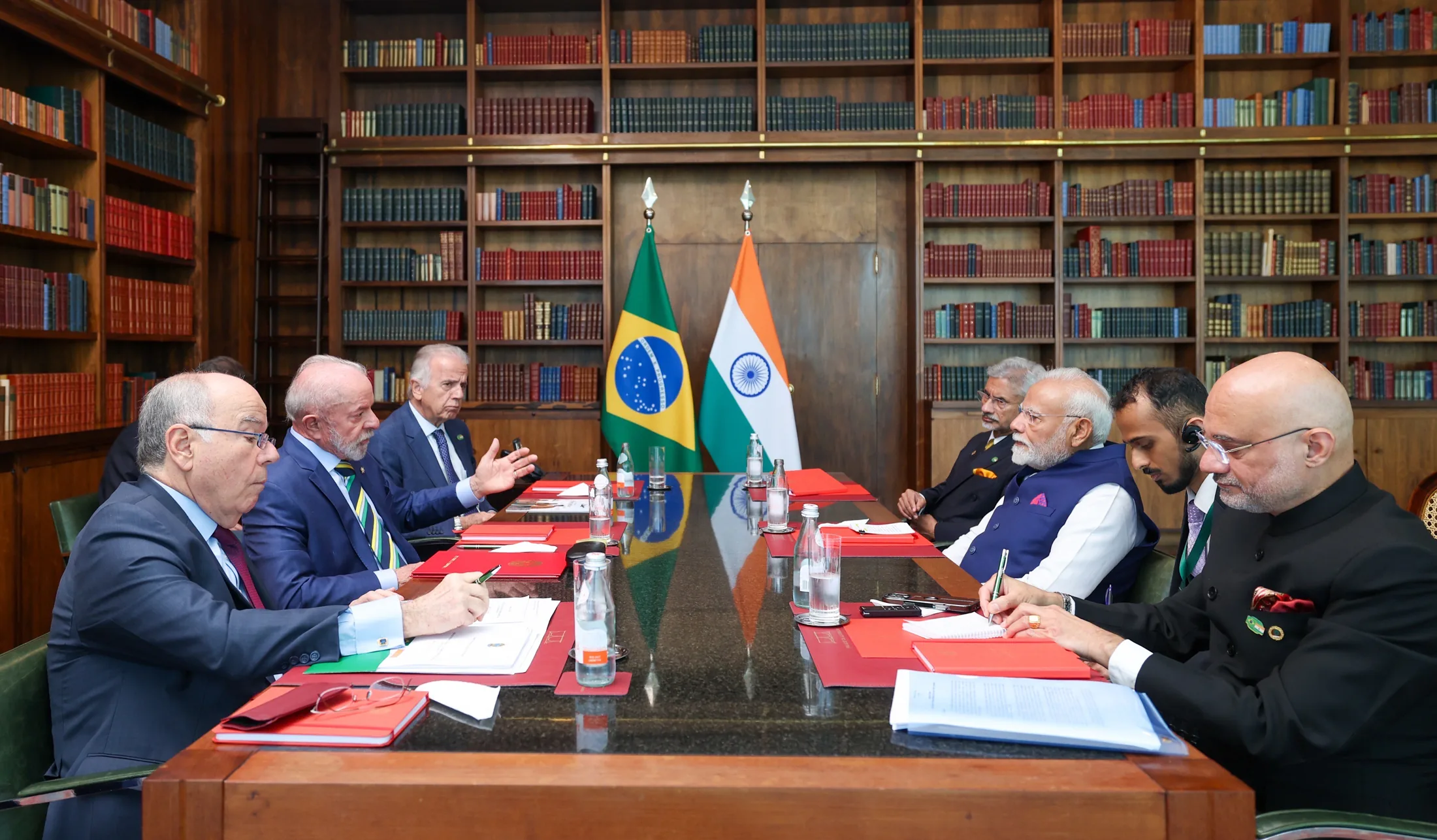
Over the past four years, the personal working chemistry between Modi and Lula has turned into one of the most active bilateral channels in the Global South. The two leaders met at the G20 Summit in New Delhi in September 2023 and again at the G20 Rio de Janeiro Summit in November 2024. In July 2025, Prime Minister Modi travelled to Brazil for both the 17th BRICS Summit in Rio and a bilateral State Visit to Brasília, where President Lula conferred upon him Brazil’s highest civilian honour, the Grand Collar of the National Order of the Southern Cross (Ordem Nacional do Cruzeiro do Sul).
Just seven months later, from 18 to 22 February 2026, Lula returned to India for his fifth presidential visit—arriving with 11 Cabinet Ministers to attend the 2nd AI Impact Summit in New Delhi and hold delegation-level talks at Hyderabad House. That continuity means Lula’s fourth term begins not with a diplomatic reset, but with a detailed roadmap already in motion.
A $15.2 billion trade corridor aiming to double to $30 billion by 2030
Brazil is today India’s largest trading partner in Latin America and the Caribbean. According to Ministry of External Affairs data, bilateral trade jumped by more than 25% in 2025 to cross $15.21 billion for the first time in history (up from $12.20 billion in 2024), with India recording a trade surplus of roughly $1.5 billion. Encouraged by that pace, Modi and Lula decided during their February 2026 talks at Hyderabad House to raise their previous $20 billion goal and target $30 billion in bilateral trade by 2030.
What makes the economic relationship resilient is that the two economies rarely compete head-to-head; instead, they supply what the other needs to grow:
What India exports to Brazil: Refined petroleum products and diesel, agrochemicals and crop-protection inputs that support Brazil’s vast agribusiness sector, pharmaceuticals and active pharmaceutical ingredients (APIs), specialty chemicals, engineering goods, auto components, and IT services.
What Brazil supplies to India: Crude oil, degummed soybean oil and raw sugar (critical to stabilizing Indian domestic food-oil and commodity supplies), gold, high-grade iron ore, and commercial and defence aircraft.
To clear bottlenecks for businesses on both sides, Brazil implemented a 10-year business visa for Indian passport holders in February 2026, signed an agreement on electronic Certificates of Origin, and joined New Delhi in pushing for a major expansion of the India–MERCOSUR Preferential Trade Agreement (PTA), which currently covers only 450 tariff lines.
Critical minerals, rare earths, and the Global Biofuels Alliance
Beyond traditional commodities, energy transition and resource security have become the centerpiece of the partnership. Brazil holds the world’s second-largest reserves of rare-earth elements along with vast deposits of lithium, niobium, nickel, manganese, and high-grade iron ore. During Lula’s February 2026 State Visit, the two governments signed landmark Memoranda of Understanding on Rare Earths and Critical Minerals and on Mining for the Steel Supply Chain—a move Prime Minister Modi described as “a major step towards building resilient supply chains.”
That government framework is already translating into industrial infrastructure. At the India–Brazil Business Forum in February 2026, India’s state-run miner NMDC, Brazilian mining giant Vale, and Adani Gangavaram Port signed an approximately $500 million tripartite pact to build an iron-ore blending facility inside a Special Economic Zone on India’s east coast to feed domestic steelmakers.
On the energy front, India and Brazil—alongside the United States—are founding architects of the Global Biofuels Alliance (GBA) launched during India’s 2023 G20 Presidency. For five decades, Brazil has led the world in sugarcane ethanol and flex-fuel automotive engineering, running a 27% ethanol blend (E27) under its RenovaBio decarbonisation framework. India, which has rapidly scaled its own ethanol blending toward 20% (E20) while cutting oil import bills and boosting farm incomes, has partnered with Brazilian institutions on second-generation biofuels, flex-fuel engines, and sustainable aviation fuel (SAF). Meanwhile, Indian public-sector energy companies—including ONGC Videsh and Bharat PetroResources—continue to hold multi-billion-dollar upstream stakes in Brazilian offshore oil and gas fields such as Parque das Conchas (BC-10) and Sergipe-Alagoas.
Embraer jets, Scorpène submarines, satellites, and digital public infrastructure
In high technology, aerospace, and defence, the bilateral footprint has expanded rapidly over the past year:
Aerospace & Defence Manufacturing: Nearly 50 aircraft made by Brazilian aerospace leader Embraer already fly in India, including the ERJ-145 airframes that carry the Indian Air Force’s indigenous DRDO Netra airborne early-warning and control (AEW&C) radar system. After opening its corporate office in New Delhi, Embraer signed a landmark agreement in February 2026 with Adani Defence & Aerospace to establish a final assembly line in India for the E175 regional jet, while also partnering with Mahindra to pitch the C-390 Millennium military transport aircraft to the Indian Air Force. At sea, a trilateral agreement between Mazagon Dock Shipbuilders Limited (MDL) and the Indian and Brazilian navies supports joint maintenance and lifecycle engineering for the Scorpène-class submarines operated by both countries.
Space Cooperation: In February 2021, the Indian Space Research Organisation (ISRO) launched Brazil’s Amazonia-1 aboard PSLV-C51 from Sriharikota—the first Earth-observation satellite entirely designed, integrated, and tested in Brazil—helping monitor deforestation in the Amazon region.
Digital Public Infrastructure & Healthcare: Under the February 2026 Joint Declaration on Digital Partnership for the Future, India is setting up a Centre of Excellence for Digital Public Infrastructure (DPI) in Brazil alongside joint work in artificial intelligence, supercomputing, and semiconductors, while technical discussions continue around linking India’s UPI and Brazil’s central-bank fast-payment system, Pix. In pharmaceuticals, Brazil’s health regulator Anvisa and India’s CDSCO signed a regulatory cooperation pact, while Brazil’s public health foundation Farmanguinhos/Fiocruz partnered with Biocon Pharma and Lupin on joint R&D for oncology, rare diseases, and neglected illnesses—including a BRL 503.4 million commitment with BahiaFarma, Biocon Biologics, and Bionovis to produce Pertuzumab breast-cancer therapy for an estimated 72,000 Brazilian patients a year.
From Gir cattle to BRICS and the UN Security Council
Beneath the state treaties lies one of the most unexpected agricultural and cultural links in the world. More than 80% of Brazil’s commercial cattle herd—over 200 million head—consists of hardy zebu cattle whose genetics trace directly back to India’s Gir, Kankrej (Guzerá), and Ongole (Nelore) breeds imported from Gujarat and Andhra Pradesh beginning in the late 19th and early 20th centuries. Adapted to tropical heat and pastures, Indian cattle lineages became the genetic backbone of Brazilian ranching and dairy farming, a bond that both nations continue to build on through joint research in dairy genomics and animal husbandry. Across Brazilian cities, Yoga and Ayurveda enjoy millions of practitioners, reinforced by Brazil’s recent agreement with India’s CSIR to access the Traditional Knowledge Digital Library (TKDL).
On the diplomatic stage, Lula’s re-election preserves a crucial axis across the world’s multilateral institutions. Together with South Africa, India and Brazil formed the consecutive Global South troika that steered the G20 from New Delhi (2023) to Rio de Janeiro (2024) and Johannesburg (2025). In BRICS, Lula hosted the 2025 Rio Summit and handed the gavel to Prime Minister Modi for India’s 2026 BRICS Presidency. And alongside Germany and Japan in the G4 alliance, New Delhi and Brasília remain two of the foremost claimants for permanent seats on a reformed United Nations Security Council—arguing that global governance in the 21st century cannot remain frozen in a 1945 post-war mould that excludes both the world’s most populous democracy and Latin America’s largest nation.
Watch Prime Minister Narendra Modi and President Luiz Inácio Lula da Silva’s joint press statements and exchange of agreements at Hyderabad House in New Delhi below (via PMO India):
Sources: Narendra Modi on Instagram, Narendra Modi on X, President Lula on X, Press Information Bureau (PIB), Ministry of External Affairs (MEA), India–Brazil Joint Statement (21 February 2026), The Hindu, The Indian Express, and FICCI.